Exhaust flanges: Why they matter more than you think
Most people don’t give their exhaust flanges a second thought. Until their exhaust starts leaking, rattling or coming apart, and a relatively small component becomes a much bigger and more expensive problem. Replacing an exhaust system or booking and attending repairs at a workshop for a simple exhaust flange is a frustrating experience, inconvenience and cost that is avoidable by picking the right exhaust system. This is exponentially the case in Australian 4WD’s as these vehicles are often subjected to harsh conditions.
Exhaust flanges are the components that join exhaust system sections together. The flanges are bolted to each other, with a gasket positioned between them to create a secure seal and prevent exhaust gases from escaping. The bolts provide the clamping pressure that holds the connection together, while the flange spreads that pressure around the gasket. If the flange corrodes, bends, cracks or comes loose, the seal can deteriorate. This can lead to exhaust leaks, rattling and additional stress on other parts of the system.
It might be a small component, but it plays an important role in keeping the exhaust securely connected and properly sealed. When you’re choosing an exhaust for a 4×4 that needs to handle corrugations, towing, mud and long-distance travel, that is worth paying attention to.
Don’t think you’re the only person that may have overlooked these crucial parts of your system, so many exhaust manufacturers do too. Many often take shortcuts to reduce manufacturing costs because they’re not designing an exhaust to stay on your 4×4 long term. Here are some questions to ask and things to check with your exhaust flanges to make sure they’re up to the task of holding up to your adventures.
1. How many bolts should an exhaust flange have?
Two-bolt flanges are the industry standard and this is sufficient for smaller exhaust systems, but most Torqit exhausts are made with three-bolt flanges for larger engines. This provides increased clamping pressure due to the additional hardware applying more pressure to the gaskets more consistently around their circumference.
The additional hardware also helps stop or mitigate leaks and system failures if one of the bolts corrodes, breaks, or comes loose and falls out over time.
Some companies use four-bolt flanges, Torqit opt not to use these as the hardware is not reinforced with as much flange material around the bolts compared to our three-bolt flanges, meaning fatigue is more likely to crack them around the bolt, or between the bolt and exhaust tubing.
Torqit find that the clamping pressure and additional hardware provided by a four-bolt flange is not worth this weakness.
2. What material should exhaust flanges be made of?
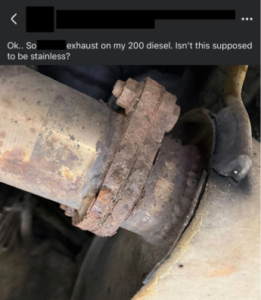
The wrong assumption to make here is that the flange is made from the same material as the rest of the exhaust system. Some brands use stainless steel in their exhaust tubing and muffler casings, but only use mild steel for their flanges to cut costs. Some will then also paint them in an attempt to resist corrosion however the paint does not last long with off-road use, and the flanges usually prematurely corrode. Check out this surprised LC200 owner who learnt this the hard way in the photo below. The flange is rusting away, and the paint has clearly worn away.
Torqit uses the same 304-grade stainless steel used in the exhaust tubing and mufflers, in the flanges. Using the same grade of stainless steel in the flanges, tubing and mufflers avoids creating a weaker point in the system that will deteriorate earlier than the surrounding components.
3. How thick should exhaust flanges be?
Many exhausts feature flanges ranging from 5–8mm thick, again to save money on production costs. Torqit uses 10 mm thick laser-cut flanges to maintain a secure connection between sections of the exhaust system. A stronger flange can also help maintain consistent pressure around the gasket and reduce the risk of leaks developing at the join.
4. Where should exhaust flanges be welded?
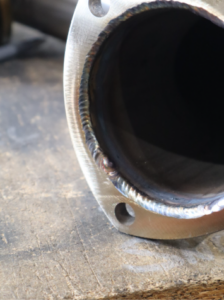
Almost every exhaust system uses a single external weld where the pipe passes through the flange, leaving the protruding end unwelded. Torqit exhausts are welded externally at one end and internally on the other end of the flange. This provides a second weld to keep the tubing attached to the flange and increases the strength of the flange without sacrificing internal diameter.
It can do this thanks to the difference in internal diameter between the flange and exhaust tubing, and the control provided by TIG welding. The extra weld ensures it’s up to keeping the system connected and stopping cracks and leaks.
5. What type of welding should exhaust flanges use?
When welding flanges, there are the options of MIG and TIG welding. Torqit are one of very few exhaust manufacturers who are TIG welding exhaust systems. TIG welding allows much better heat control over the welds, controlling the area affected by heat, resulting in a stronger weld that is less prone to cracking. It also allows for a much tidier looking weld with no spatter.
Exhaust flanges may not be the first feature you notice when comparing exhaust systems, but they play an important role in keeping the system securely connected and properly sealed. Looking at the bolt configuration, material, thickness and welds can help you understand whether an exhaust has been engineered for long-term performance or simply to look good out of the box.