Boosting 4WD Performance: The Role of Power Modules in Modern Vehicles

If you have ever pulled away from a set of lights with a caravan on the back and thought there has to be more in this engine, you are not wrong. Modern diesel 4WDs are deliberately held back from the factory.
Manufacturers tune for the widest possible range of conditions, fuel grades, and driver habits, which means your rig is almost certainly leaving performance on the table.
A Torqit diesel performance module is one of the most effective ways to reclaim it, without touching your ECU, voiding your warranty, or spending a week at a workshop.
This guide covers everything you need to know: how an integrated power module actually works, how it compares to a full ECU remap and basic diesel chips, and why Australian driving conditions make the case for tunable, configurable performance stronger than anywhere else in the world.
If you are researching a 4WD power upgrade, this guide covers everything you need to choose the right one.
What Actually Holds Your 4WD Back from the Factory
Automotive manufacturers are conservative by design. When Toyota, Ford, or Isuzu maps the tune on your engine, they are not building for you specifically.
They are building for a fleet buyer in Jakarta, a pensioner doing 8,000 km a year on sealed road, and a tradie in Queensland towing a trailer in 40-degree heat, all with the same software.
The result is a tune that prioritises reliability margins and emissions compliance over the performance your engine is physically capable of delivering.
Common-rail diesel tuning from the factory controls fuel pressure and injection timing with precision. The engine management system reads from multiple sensors and adjusts fuelling accordingly.
That system is intentionally conservative. The rails, injectors, and turbo on most modern 4WDs can handle significantly more than the factory map asks of them.
An integrated power module intercepts specific signals in that chain and expands what the engine is asked to do, within parameters that remain safe and stable.
The gap between factory output and what your engine can genuinely produce is real and meaningful.
It shows up exactly where you notice it most: pulling a heavy trailer up a range, crawling through corrugated dirt at low revs, or trying to maintain highway speed when a headwind hits.
What Is an Integrated Power Module?
The term gets used loosely in the performance market, so it is worth being specific.
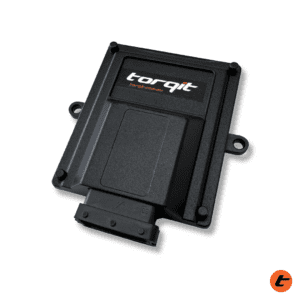
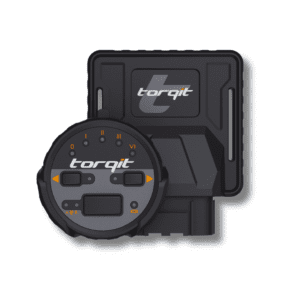
An integrated power module is a precision device that connects to your vehicle’s fuel pressure sensor and modifies the signal the ECU receives, prompting it to increase fuel delivery and adjust injection timing. The word “integrated” matters here.
Unlike a basic single-input chip or power distribution module, a quality integrated module is designed to work in harmony with the engine’s existing systems rather than crudely overriding a single parameter.
How the Common-Rail Fuel Signal Works
Common-rail diesel engines work by maintaining high-pressure fuel in a rail that feeds all injectors simultaneously. The ECU controls how much fuel enters the combustion chamber by monitoring fuel rail pressure via a dedicated sensor.
When your foot hits the accelerator, the ECU reads the pressure signal, calculates the appropriate injection event, and tells the injectors exactly how long to open.
A power module connects directly to this fuel pressure sensor. It sits between the sensor and the ECU, adjusting the pressure signal within a controlled range.
The ECU interprets the adjusted signal as a request to deliver more fuel. More fuel, managed correctly, means more energy in the combustion event, which translates to more torque and power.
Because the module is working within the ECU’s own feedback loop, the engine management system continues to handle all its normal safety and protection functions.
What Automotive Power Chips Actually Change
The term automotive power chips covers a wide range of products with very different levels of sophistication. At the basic end, a chip might modify a single signal with a fixed value.
At the other end, a properly engineered integrated module provides multiple tuned maps, each with multiple adjustment levels, and handles signal management in a way that responds to real-time engine conditions.
What changes in practice: you feel more torque through the mid-range, which is the rev range you actually use when towing or driving off-road.
Throttle response feels more immediate and linear. On long highway runs, the engine reaches cruising loads more efficiently, which feeds into fuel economy. The physical hardware in your engine does not change.
Your warranty situation does not change. What changes is the instruction set your ECU uses to operate an engine that was already capable of more.

Power Module vs ECU Remap vs Basic Chip: What’s the Difference?
These three options dominate the performance market and get compared constantly.
Each has a genuinely different use case, and the right choice depends on what you are doing with your vehicle, how much you want to spend, and how reversible you need the modification to be.
Basic Plug-and-Play Chips
At the entry level, you will find resistor-based chips and basic fuel signal devices that do one thing: raise the fuel pressure signal by a fixed amount. They are cheap, and they are blunt instruments.
There is no tuning capability, no adjustment for different driving conditions, and no sophistication in how the signal is managed. You get a single modification applied at all times.
For a driver who never tows, never goes off-road, and just wants a bit more response on the highway, a basic chip might tick the box. For anyone doing varied work with their vehicle, the lack of control is a real limitation.
Full ECU Remap
A full ECU remap is the best powertrain upgrade diesel engines can receive, rewriting the software on your engine control unit.
Done well by a skilled tuner, it can extract serious performance gains and optimise the entire engine map rather than modifying a single signal.
The tradeoffs are real, though. A remap is not reversible in any practical sense. It typically voids your manufacturer’s powertrain warranty.
It requires your vehicle to be off the road during the remap process. And the quality of the outcome depends entirely on the tuner: a remap from a careless shop can cause real damage.
For a daily driver that is also a family vehicle, those risks add up.
Torqit’s ModuleMap is the remote remap option for drivers who want that level of performance optimisation but with Torqit’s engineering behind it.
Three custom tunes, remote delivery, genuine ECU-level changes. If your vehicle is a dedicated performance or competition build, that is the direction to consider.
Integrated Power Module
A quality integrated power module is the ECU remap alternative that hits a sweet spot that most Australian 4WD owners actually need.
It is plug-and-play: no workshop downtime, no permanent software changes to your ECU. It is fully reversible: unplug it, reinstall the original connector, and your vehicle returns to factory spec with zero trace.
Your factory warranty remains intact. And with the right module, you get genuine tunability across multiple maps and multiple settings within each map.
That reversibility matters more than people often think.
Lease vehicles, fleet vehicles, vehicles you plan to sell, vehicles still under warranty: a plug-and-play performance module lets you run genuine performance upgrades right up until the moment you need to hand the keys back, then remove it completely.
Real-World Benefits for Australian 4WD Drivers
Australia’s driving landscape is unlike anywhere else, which shapes what a 4×4 performance upgrade Australia-wide needs to deliver.
You have sealed highway runs that stretch for hundreds of kilometres, red dirt corrugations that would shake a city car to pieces, genuine heat, genuine dust, and genuine loads.
The performance demands on an Australian 4WD are more varied and more demanding than almost any other market in the world. That context shapes exactly what kind of upgrade makes sense.
Towing and Heavy Loads
Towing performance diesel 4WDs need most is low-end torque, and that is exactly where the power module gains are most immediately felt.
When you are hauling a loaded camper trailer up a long grade in Queensland summer heat, the factory tune’s conservative fuelling is a real limitation.
You are sitting at lower revs than you want to be, the turbo is working hard, and you are either slowing down the whole convoy or downshifting constantly.
A power module’s sport tune adds torque through the mid-range where you need it most for towing. You spend less time in the wrong gear, the engine runs more efficiently at the load it is actually under, and the whole experience feels more controlled.
For drivers regularly towing caravans, horse floats, or equipment trailers, this is where the investment pays off fastest.
Off-Road Control
Low-speed control on rough terrain comes down to how smoothly and predictably your engine delivers torque. On corrugated outback roads or technical rocky tracks, you want a linear response: ask for a little, get a little.
Factory tunes often have a dead zone followed by a surge, which makes low-speed finesse harder than it should be.
With the cruise tune dialled in at a mid-range setting, you get a more progressive, predictable power delivery that suits technical terrain. You can modulate your speed through rough sections without wrestling the throttle.
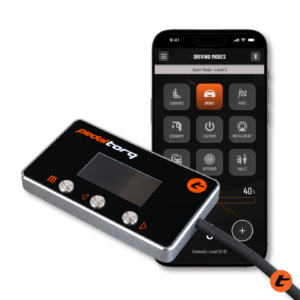
Pair this with a throttle controller 4WD owners rely on (the Pedal Torq) to eliminate throttle lag at the pedal level, and off-road control improves dramatically.
Fuel Efficiency on Long Runs
There is a common misconception that adding performance always costs fuel. The opposite is often true when the modification is properly engineered.
On a long highway run, the eco tune on a power module allows the engine to reach and maintain cruising loads more efficiently.
The engine does not have to work as hard to sustain highway speed, especially when loaded. Torqit customers regularly report fuel savings of 10 to 15 percent on long touring runs using the eco tune.
For a vehicle covering 600 km a day on a Cape York run or a Gibb River Road tour, that fuel saving matters both financially and logistically. Fewer jerry can stops. More range between towns. Less time stressing about the next fuel point.
The Torqit Power Module: Three Tunes, 27 Settings
Most performance modules on the market offer three fixed settings: low, medium, high. That is it. Torqit builds differently. The Torqit Power Module ships with three full tunes, and within each tune, there are nine individual adjustment steps.
That is 27 distinct configurations in total, a level of tuning granularity no other plug-and-play module on the Australian market can match.
Here is what each tune is designed for:
- Eco: optimised for fuel economy on highway and touring runs. Wind it into the range that suits your vehicle and load, and you will get genuine efficiency gains without sacrificing everyday drivability.
- Cruise: a balanced all-rounder. This is most drivers’ default setting for mixed driving, commuting, and moderate off-road use. It improves response and torque without pushing the engine hard.
- Sport: maximum performance for towing, overtaking, and demanding terrain. When you need the engine to work, the sport tune puts everything Torqit’s engineers have extracted from your fuelling system on call.
The nine steps within each tune let you fine-tune the intensity to your specific vehicle, load, and conditions. You might run eco at step 5 on a solo highway run and sport at step 7 when you are towing your full caravan kit.
No other module on the Australian market gives you that range of control without going all the way to an ECU remap.
The module is a plug-and-play fit for your vehicle’s common-rail fuel pressure sensor, and it takes less than 30 minutes to install for most vehicles.
Remove it in the same amount of time, and your vehicle returns to factory spec, zero trace. The module power supply draws from the vehicle’s existing electrical system without additional wiring or modification.
Backing it up: a 5-year warranty, a 30-day money-back guarantee, and German-manufactured circuitry.
Torqit is also the only company in Australia that manufactures all of its own 4×4 performance products in-house, which means the quality control on these modules is not outsourced. Every unit is engineered and built to the same standard.
Not sure which module suits your exact vehicle? Use the vehicle selector on the Torqit website to confirm compatibility with your make, model, and year.
Power Module Plus: When You Want App Control
The Torqit Power Module Plus delivers everything in the standard Power Module, with one significant addition: Bluetooth connectivity via the Torqit Drive App.
If you want to change tunes and settings from your phone without reaching under the bonnet, the Plus is the one to choose.
The same three tunes, the same 27 configurations. But you can switch between them on the fly from the Torqit Drive App. Pull up to a tough section of track and bump to sport tune.
Hit the highway and drop back to eco. The Power Module Plus also supports hardwired in-cabin operation if you prefer a dedicated controller without using your phone.
At the same RRP of $1,890, the Plus and the standard module are priced identically. The decision comes down to how you like to operate.
If you switch tunes frequently based on conditions, the app control is a genuine quality-of-life upgrade. If you set your tune and leave it, the standard module does everything you need.
Is a Power Module Right for Your 4WD?
A power module is not the right upgrade for every vehicle or every driver. Here is how to think about whether it fits your situation.
A power module is a strong fit if:
- You drive a common-rail diesel 4WD, which covers the vast majority of Australian utes, wagons, and SUVs made in the last 15 years.
- You want genuine performance gains without ECU changes, especially if your vehicle is still under warranty or on a lease.
- You regularly tow, load up, or drive demanding off-road terrain where more torque and better throttle response make a practical difference.
- You want the ability to remove the modification completely, whether for a service, a resale, or a warranty claim.
- You want tunable, adjustable performance rather than a single fixed setting.
A power module may not be the right first choice if:
- You are building a dedicated competition or extreme performance vehicle where maximum output is the only priority. In that case, a full ECU remap like the Torqit ModuleMap is likely the better path.
- Your vehicle does not run a common-rail diesel system. Petrol engines and older mechanically injected diesels operate differently, and a fuel pressure module is not the appropriate tuning method.
For the majority of Australian 4WD owners, a power module combined with a Pedal Torq throttle controller gives the most well-rounded performance result.
The power module addresses fuelling and torque output. The throttle controller eliminates electronic throttle lag so the power you have unlocked actually gets to the wheels the moment you ask for it.
Together, the improvement in drivability is noticeable in every driving condition.
Frequently Asked Questions
Common questions from 4WD owners considering a power module upgrade, answered straight.
Will a power module void my factory warranty?
No, provided the module operates within factory parameters, which Torqit’s modules are specifically engineered to do.
The module is also fully reversible: remove it before any warranty-related service or inspection, and your vehicle returns to exactly factory spec. There is no trace left on the ECU. Your manufacturer has no way to detect the module was ever fitted.
How does an integrated power module differ from a basic diesel chip?
A basic chip modifies a single signal at a fixed rate. An integrated power module is a more sophisticated device that manages the fuel pressure signal with precision, offers multiple tuned maps, and includes multiple adjustment steps within each map.
The result is a system you can configure to your actual driving conditions rather than one fixed setting applied at all times.
What vehicles are compatible with the Torqit power module?
Torqit Power Modules are compatible with a wide range of common-rail diesel 4WDs, including popular models from Toyota, Ford, Isuzu, Mitsubishi, Nissan, and others.
Use the vehicle selector on the Torqit website to confirm compatibility with your specific make, model, and year.
How long does installation take?
Most drivers complete the installation in under 30 minutes. The module connects to your vehicle’s common-rail fuel pressure sensor using a plug-and-play connector.
No cutting, splicing, or modification to your vehicle’s wiring is required. The same process applies in reverse to remove it.
What is the difference between the Power Module and the Power Module Plus?
Both modules share the same three tunes and 27 total settings. The Power Module Plus adds Bluetooth connectivity via the Torqit Drive App, allowing you to switch tunes and adjust settings from your phone without physically accessing the module.
The Plus also supports hardwired in-cabin control. Both are priced at RRP $1,890.
Can I use a power module and an ECU remap together?
Running both at the same time is not recommended. A power module and an ECU remap both modify fuelling parameters, and running them simultaneously can push fuel delivery outside safe limits.
Choose one approach: a power module for plug-and-play, reversible performance, or the Torqit ModuleMap for a full ECU-level remap. If your needs evolve, you can always remove the power module and proceed with a remap later.
What kind of power gains can I realistically expect?
Results vary by vehicle, tune selection, and settings, so specific numbers are not quoted here as a guarantee.
What you can expect: noticeable torque improvement through the mid-range, better throttle response, and on long runs using the eco tune, fuel savings that Torqit customers regularly report in the range of 10 to 15 percent.
The sport tune delivers the most significant power increase and is most useful for towing and performance driving.
Does a power module affect the vehicle’s electrical system?
No. The module draws its power supply from your vehicle’s existing electrical system via the fuel pressure sensor connection. There is no separate wiring, no additional fuse requirements, and no meaningful draw on your vehicle’s electrics.
The module power supply is self-contained within the plug-and-play connection, which is one of the reasons installation is so straightforward.
Ready to Unlock What Your 4WD Is Already Capable Of?
The Torqit Power Module gives you three tunes, 27 settings, and a fully reversible installation that takes less than 30 minutes.
No workshop. No permanent modifications. No warranty concerns. Just the performance your vehicle was always capable of delivering.
Browse the full Power Module range or explore the Power Module Plus with Bluetooth control. Use the vehicle selector to confirm fitment for your exact make, model, and year, and find out what your 4WD has been holding back.